
Request Pricing
Get current pricing, available quantities,
photos, videos, and shipping options.
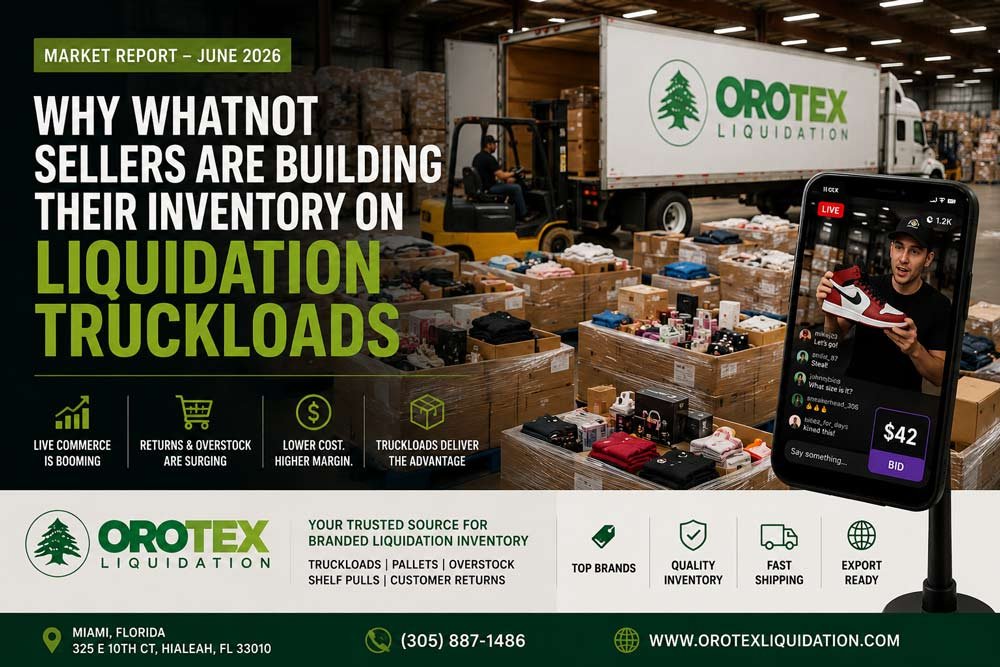
A new kind of retailer has moved to the front of the wholesale liquidation line: the live seller. The host running back-to-back auctions on Whatnot, the closet flipper streaming sneakers at midnight, the beauty creator unboxing returns on camera — these operators now consume branded surplus inventory at a pace that traditional resellers rarely matched. The reason is simple. Live commerce rewards speed, variety, and recognizable brands, and the only sourcing channel that delivers all three at a workable cost is the liquidation truckload.
At Orotex Liquidation, we sit on the supply side of that equation. From our Miami, Florida warehouse we move pallets and full truckloads of overstock, shelf pulls, and customer returns from major U.S. retailers into the hands of wholesalers, exporters, flea-market vendors, and — increasingly — live sellers. This report looks at the numbers behind that shift, why it is structural rather than a fad, and what it means for anyone sourcing brand-name goods at scale.
For years the question around U.S. live shopping was whether it would ever work outside of China. That question is now closed.
EMARKETER reports that U.S. livestream e-commerce sales grew nearly 50% in 2025 to reach roughly $14.6 billion, with the number of live-shopping buyers climbing more than 21% year over year. Globally the format is even larger: industry analysts pegged livestream commerce at about $128 billion in 2024, with long-range projections running into the trillions over the next decade. China remains the proof of concept, having scaled live shopping from tens of billions of dollars a few years ago to well over half a trillion annually.
Whatnot is the clearest U.S. success story. By the platform’s own 2025 reporting it crossed roughly $8 billion in live gross merchandise value — more than double the prior year — generated over $1 billion in revenue, and saw more than 20 million new accounts created in a single year. Investors validated the trajectory in late 2025, when a $225 million funding round valued the company at about $11.5 billion. Engagement is the part that should interest every supplier: viewers reportedly spend around 80 minutes a day inside the app, a number that dwarfs the typical social feed and explains why merchandise sells through so quickly during a show.
The most important detail for sourcing, though, is the seller economics. Whatnot has noted that a majority of its sellers now earn the bulk of their annual income on the platform, hundreds have crossed seven figures in annualized sales, and a growing share run it full time. People earning a living this way do not buy inventory once. They buy constantly.
Trading cards, sneakers, and collectibles built Whatnot. The 2025 expansion, however, came from categories that look a lot like a typical liquidation truckload manifest.
Platform data circulated in early 2026 showed beauty growing close to 800% year over year, electronics up more than 400%, jewelry up roughly 260%, and women’s fashion up over 220%, with new buyers up nearly 290%. Those are exactly the departments that flow through secondary-market channels in volume — cosmetics, apparel, footwear, small electronics, accessories, and general merchandise. The categories now driving live-commerce growth and the categories that fill liquidation loads have effectively converged.
That convergence is why a sourcing relationship that once felt optional has become a procurement strategy.
Live sellers need a firehose of branded goods. The U.S. retail system produces exactly that, by accident, every single day.
The National Retail Federation projected total U.S. retail returns of roughly $850 billion in 2025, at a return rate near 16% overall and close to 19% for online orders. Returns are only part of the picture; overstock, canceled orders, packaging changes, discontinued lines, and seasonal carryover add still more volume. Crucially, retailers cannot simply re-shelve all of it. Industry estimates suggest that fewer than half of returned items are sold at full price, and processing a single return can cost a retailer tens of dollars once shipping and labor are factored in.
The result is a continuous river of branded, sellable merchandise that the original retailer has every incentive to move out quickly and cheaply. Analysts tracking the broader liquidation and reverse-logistics ecosystem describe a market measured in the hundreds of billions of dollars, expanding steadily as e-commerce return volume grows. For a live seller, that river is the inventory base their entire business model depends on — and the truckload is how it gets delivered at a cost that leaves room for profit.
A traditional online store can list a product once and let it sell over weeks or months. Live selling does not work that way. The format runs on real-time demand, scarcity, and momentum, which creates a very specific set of sourcing pressures:
A full truckload answers all four at once: a large, mixed, brand-heavy shipment at the lowest cost per unit available in the channel. As Orotex has long advised buyers, a complete truckload almost always beats buying single pallets or Gaylord boxes on cost, simply because volume compresses the per-unit price and improves margin for the reseller.
Live sellers are not buying cheap for sport — they are managing thin, fast-moving margins. On Whatnot, the standard commission sits around 8% and drops on certain collectible categories, but once payment processing is layered in, the realistic platform cost runs in the low double digits as a share of gross on a typical show. Add shipping, handling, and the occasional dud SKU, and the only reliable lever a seller fully controls is the landed cost of goods. That is precisely why sourcing has shifted from opportunistic to deliberate: the cheaper and more consistent the inventory, the more room there is to discount on air, win the bid, and still keep the show profitable.
Not every truckload suits every live seller, and choosing the wrong type is where new buyers lose money.
The right answer depends on the seller’s risk appetite and the show format. What does not change is the supplier’s importance. Especially in an unmanifested deal, you are buying the liquidator’s sorting standards and honesty as much as the goods.
Truckload sourcing is powerful, not effortless. The same characteristics that make it cheap also introduce operational realities every live seller should budget for:
The sellers who win do two things: they specialize in a category they understand, and they build a repeat relationship with a supplier they trust rather than chasing the cheapest one-off deal.
The live-commerce buyer is reshaping demand up and down the chain.
Retailers achieve faster, larger clearance of returns and overstock, freeing warehouse space and recovering value from goods that would otherwise sit idle or be destroyed. Liquidators see rising demand for loads rich in recognizable brands and broad assortment, because that is what performs on camera. Wholesale distributors are curating more—assembling mixed loads specifically for e-commerce and live sellers rather than generic bulk. And exporters, particularly those serving Latin American and other international markets where live shopping is also growing, continue to absorb large volumes of branded U.S. surplus.
For a Florida-based liquidator shipping nationwide and worldwide, that international dimension matters. Branded U.S. liquidation goods carry strong perceived value abroad, and live commerce is expanding in many of those same markets.
Everything in this report points the same direction. Live commerce is still early and growing fast; the categories driving it overlap heavily with those from retail returns and overstock; and the return tide that feeds liquidation is structural, not cyclical. As long as Americans buy online and send roughly a fifth of it back, branded surplus will keep flowing — and as long as live selling rewards speed, brands, and variety, sellers will keep reaching for the truckload to feed it.
The operators who treat sourcing as a discipline — knowing their category, choosing manifested or unmanifested deliberately, and partnering with a supplier who sorts honestly and restocks reliably — are the ones who will hold margin while the format gets more crowded.
That is the role Orotex has played for more than two decades. We work strictly business-to-business, source overstock, shelf pulls, and customer returns from major U.S. retailers, receive fresh truckloads on a continuous basis, and build long-term relationships rather than one-time sales. For live sellers, flea-market vendors, online resellers, and exporters trying to keep a constant supply of brand-name inventory moving, that consistency is the difference between a good month and a sustainable business.
Orotex Liquidation supplies pallets and full truckloads of overstock, shelf pulls, and customer returns from major U.S. retailers — shipped from our Miami, Florida warehouse, nationwide and internationally.
📞 (305) 887-1486 ✉️ hello@orotexliquidation.com 🌐 orotexliquidation.com
We speak English, Spanish, French, and Arabic. B2B only.
Figures in this report are drawn from publicly reported data including EMARKETER livestream commerce forecasts, Whatnot’s 2025–2026 platform reporting, and the National Retail Federation 2025 Retail Returns Landscape, alongside Orotex Liquidation operating experience. Market projections are estimates and may change with consumer and platform trends.