
Request Pricing
Get current pricing, available quantities,
photos, videos, and shipping options.

Understand the retail cycle, why overstock happens, and how liquidation inventory reaches the wholesale market.
Every pallet of liquidation merchandise has a story. Some inventory was ordered for a season that ended, some exceeded retail demand, and some was discontinued, repackaged, or redirected before reaching store shelves. Understanding how retail liquidation works explains why that inventory exists in the first place, why it’s priced the way it is, and what you’re actually buying when you purchase a pallet or a truckload.
This guide walks through the full cycle: how merchandise becomes excess, who handles it along the way, and how it ultimately becomes available to wholesale buyers, exporters, and resellers.
Retail liquidation is the process of selling excess, seasonal, discontinued, shelf-pull, or returned merchandise in bulk — usually below regular wholesale cost — so the original seller can recover cash and free up space quickly.
The keyword is quickly. A retailer isn’t trying to maximize the price of leftover inventory. It’s trying to convert a warehousing problem back into working capital before the next season’s goods arrive. That urgency is exactly what creates the margin opportunity for downstream wholesale buyers.
Liquidation is not the same as traditional wholesale. A traditional wholesale supplier usually buys new production from a manufacturer and sells it by the case at a predictable price. A liquidator moves merchandise that has been released outside the retailer’s normal sales channel. Some goods reached store shelves, while others remained in distribution centers or were redirected before ever reaching a store. That is why liquidation offers lower costs, changing assortments, and limited availability.
Not familiar with a term in this guide? Our wholesale and liquidation glossary defines the vocabulary buyers see on manifests and quotes.
Overstock isn’t a sign that something went wrong. It’s a normal part of how modern retail operates. Five forces produce it consistently:
Retail buyers commit to quantities six to twelve months ahead of a selling season. They forecast against weather, trends, and consumer confidence — all of which move. Order too little and you lose sales; order too much and you carry the excess. Large retailers deliberately order with a margin of safety, because a stockout costs more in lost revenue than surplus costs in liquidation.
Customer returns represent one major source of liquidation merchandise in the U.S. According to the National Retail Federation’s 2025 Retail Returns Landscape, retailers expected 15.8% of annual sales to be returned in 2025 — roughly $849.9 billion in merchandise. Online returns run higher still, at an estimated 19.3% of e-commerce sales.
Once an item comes back, it rarely goes straight to the shelf. Repackaging, inspecting, and restocking single units can cost more than the item’s remaining margin. Instead, those goods are consolidated, palletized, and sold in bulk.
Store planograms reset on a fixed calendar. When spring merchandise arrives, winter merchandise has to move — regardless of whether it sold. Items pulled from shelves that are still new or nearly new become shelf pulls, one of the most desirable liquidation categories because condition is high.
A packaging redesign, a discontinued color, a brand refresh, or a supplier change can make existing stock harder to sell through the original retail channel — even if the product itself is brand new. That inventory becomes closeouts.
Consolidations, downsizing, and shifts toward e-commerce release large volumes of inventory at once. These loads tend to be large, mixed, and time-sensitive, which is why they often move as full truckloads.
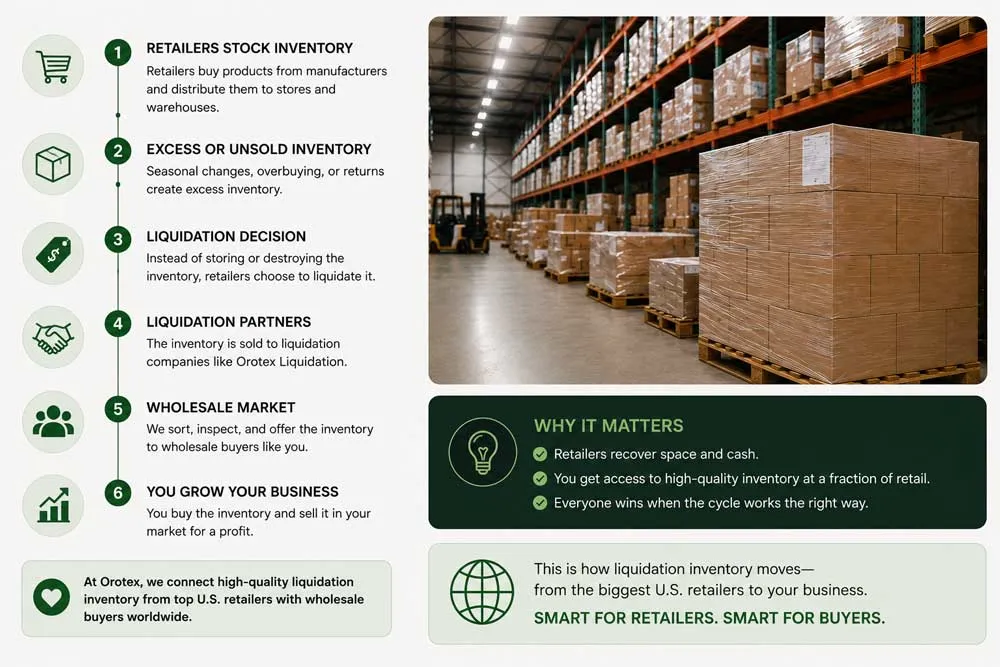
Here is the path merchandise typically takes from the retail supply chain to a wholesale pallet:
Not every load travels the full path. Overstock and closeout programs often move from the retailer to the wholesale buyer with very little handling, whereas mixed-return loads pass through more stages before reaching a pallet.
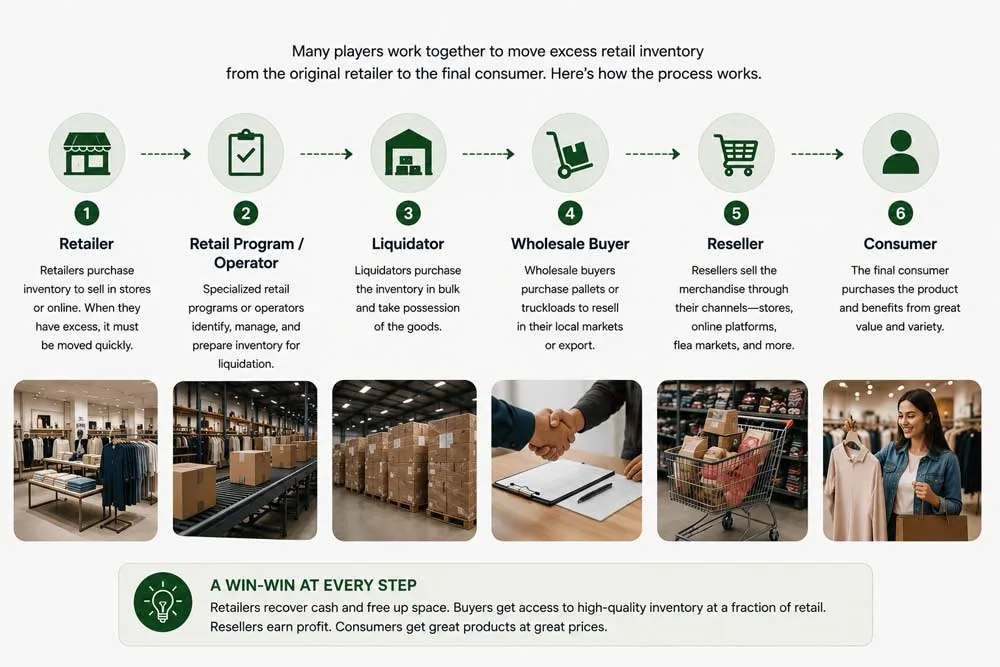
Four types of players handle merchandise between the original retail channel and the reseller. Knowing which one you’re buying from matters more than most buyers realize:
| Player | Role | What it means for you |
|---|---|---|
| Retailer/brand | Releases excess inventory | Sets the original category, condition, and mix |
| Retail program/processor | Consolidates inventory at scale | Determines how much grouping or sorting has already happened |
| Liquidator / wholesaler | Buys loads, organizes, grades, and resells | Physically owns and handles the goods before resale |
| Broker | Resells loads without holding them | Adds a margin layer with less visibility into the merchandise |
Every additional hand between the original retail channel and you does one of two things: it either adds value through access, organization, photos, inspection, or grading, or it adds cost without adding visibility to the load. That distinction is the clearest way to judge a liquidation source.
Not all liquidation inventory is equal. The main categories, roughly from highest to lowest condition:
A load described as “overstock” and one described as “customer returns” can carry similar retail values yet yield completely different resale outcomes. For a deeper breakdown of what actually shows up inside a pallet, see what liquidation pallets are and what’s inside them.
Liquidation loads are evaluated as a percentage of extended retail—the combined retail value of all items in the load. A pallet with $10,000 in extended retail sold for $1,500 carries a 15% cost percentage.
That percentage matters, but it does not tell the whole story. A cheap pallet can still be a weak buy if the mix is difficult to resell, while a higher-priced load can perform better if the goods are clean, current, and easy for your customers to understand. Several factors influence the real value:
The seller’s equivalent metric is the recovery rate: how much of the original value they recouped. Buyer cost percentage and seller recovery rate are two views of the same number, but buyers should always compare that number against condition, category, freight, and resale demand.
A few practical takeaways from how the cycle actually works:
Supply is inconsistent by nature. Liquidation inventory depends on what retailers release, not on a production schedule. Consistent access usually comes from a supplier with standing relationships, not from one-off spot purchases.
Fewer hands means better visibility. Each intermediary adds margin. When the company selling you a load also handles and presents it, you know what you’re paying for.
Inspection beats description. Grades and manifests are useful, but they’re descriptions. Seeing the merchandise — in person or through current photos and videos — is the best way to verify its condition before committing.
Freight is part of the cost. A cheap pallet three states away can cost more delivered than a fairly priced one nearby. Factor shipping into every comparison, especially for export loads.
Orotex Liquidation operates in the wholesale stage of this chain. We source excess inventory from major U.S. department stores and national retail programs, bring available merchandise into our Miami warehouse, organize it by category and condition, and sell it as pallets and truckloads to resellers, distributors, and export buyers.
We’re not a broker. Available inventory can be inspected in person at our Hialeah warehouse, and incoming programs are presented with current photos, details, and availability before you commit. For international buyers, Miami’s port and airport access makes it a practical consolidation point for Latin America and the Caribbean.
At Orotex, we believe understanding why liquidation inventory exists is the first step toward buying it correctly. When you know the source, condition, season, and intended market for the merchandise, you can evaluate its actual resale potential rather than judging a load solely by price.
Want to see what’s currently available? Browse current lots or contact our warehouse team for pricing, photos, and availability.
Retailers identify excess, seasonal, shelf-pull, returned, or discontinued merchandise, consolidate it into bulk loads, and release it to the secondary market. Liquidation companies acquire those loads, organize or grade the merchandise as needed, and resell them as pallets or truckloads to wholesale buyers and resellers, who then sell them to end consumers.
Shelf space and warehouse space cost money, and buying commitments are made months in advance. Selling excess inventory in bulk recovers cash faster than repeatedly marking it down in-store and frees up space for incoming seasonal merchandise.
Not necessarily. Liquidation covers a wide range of conditions — overstock and shelf pulls are typically brand new, closeouts are usually new but discontinued, while customer returns and salvage vary considerably. The grade listed on a load tells you what to expect, which is why inspecting before buying matters.


